County of Santa Cruz

Housing Dashboard

We all deserve housing

The housing crisis in Santa Cruz County and across California is rooted in over 40 years of State and local policies that have failed to produce enough housing to meet the needs of our local families and individuals. This has resulted in skyrocketing housing costs, scarce housing supplies, and high levels of homelessness. Through updates to our General Plan and strategic investments, the County is working to create housing for all, including more than 1,900 safe, affordable units for low- and moderate-income households, often paired with wraparound services to help individuals and families and thrive.

Housing Production

In 1978, voters passed Measure J, an initiative requiring the Board of Supervisors to adopt a Growth Management System for the County of Santa Cruz. In 1979, County staff reported the initiative could “accelerate the increase in housing costs” and proposed more aggressive programs to provide affordable housing for low- and moderate-income households. However, many of those proposed programs were not implemented.

Most of the County’s income-restricted affordable housing was built with support from redevelopment funding, which the State ended in 2011. Since then, new affordable housing projects have relied heavily on one-time State and federal grants and other funding sources. Today, the County is focused on creating a mix of environmentally responsible market rate and affordable rental housing to meet the needs of teachers, nurses, service-industry workers and others who help make Santa Cruz County a great place to live.

Chart 1: Since 1980, Santa Cruz County added about 80,000 people and only 28,000 housing units.


Homelessness

Homelessness is one of the most visible consequences of the housing crisis. To address homelessness directly, the Board of Supervisors created the Housing for Health (H4H) Division in 2020 to oversee programs focused on preventing and resolving homelessness. H4H also provides staffing support to the Housing for Health Partnership (H4HP), the federally designated Continuum of Care (CoC) for Santa Cruz County. The CoC brings together local government, housing and service providers, nonprofit organizations, people with lived experience and other community partners to coordinate efforts to address homelessness.

Together, the H4H Division and H4HP work to help people experiencing homelessness, especially the most vulnerable, either connect with the services and support they need or move into housing. While homelessness continues to affect many people throughout California, the County has made significant investments that have laid the groundwork for more progress.

Chart 2: Housing for Health Partnership Data on Homelessness

ADDITIONAL RESOURCES

Strategic Framework

Every three years, the H4HP engages with the community to update its strategic framework and guide efforts to reduce homelessness across Santa Cruz County.

Strategic Framework

Coordinated Entry

Through the Coordinated Entry process, Connectors help people experiencing homelessness connect to services and find solutions to their housing needs.

Coordinated Entry

Housing Resources

Through its partnership with United Way 211, H4HP helps people find information about sober living homes, interim shelters, safe parking, and affordable housing options.

Housing Resources

Mental Health Services

Maintaining Ongoing Stability through Treatment (MOST) team embeds Mental Health Liaisons with law enforcement to rapidly respond to calls for mental health support.

Mental Health Services

Affordable Housing

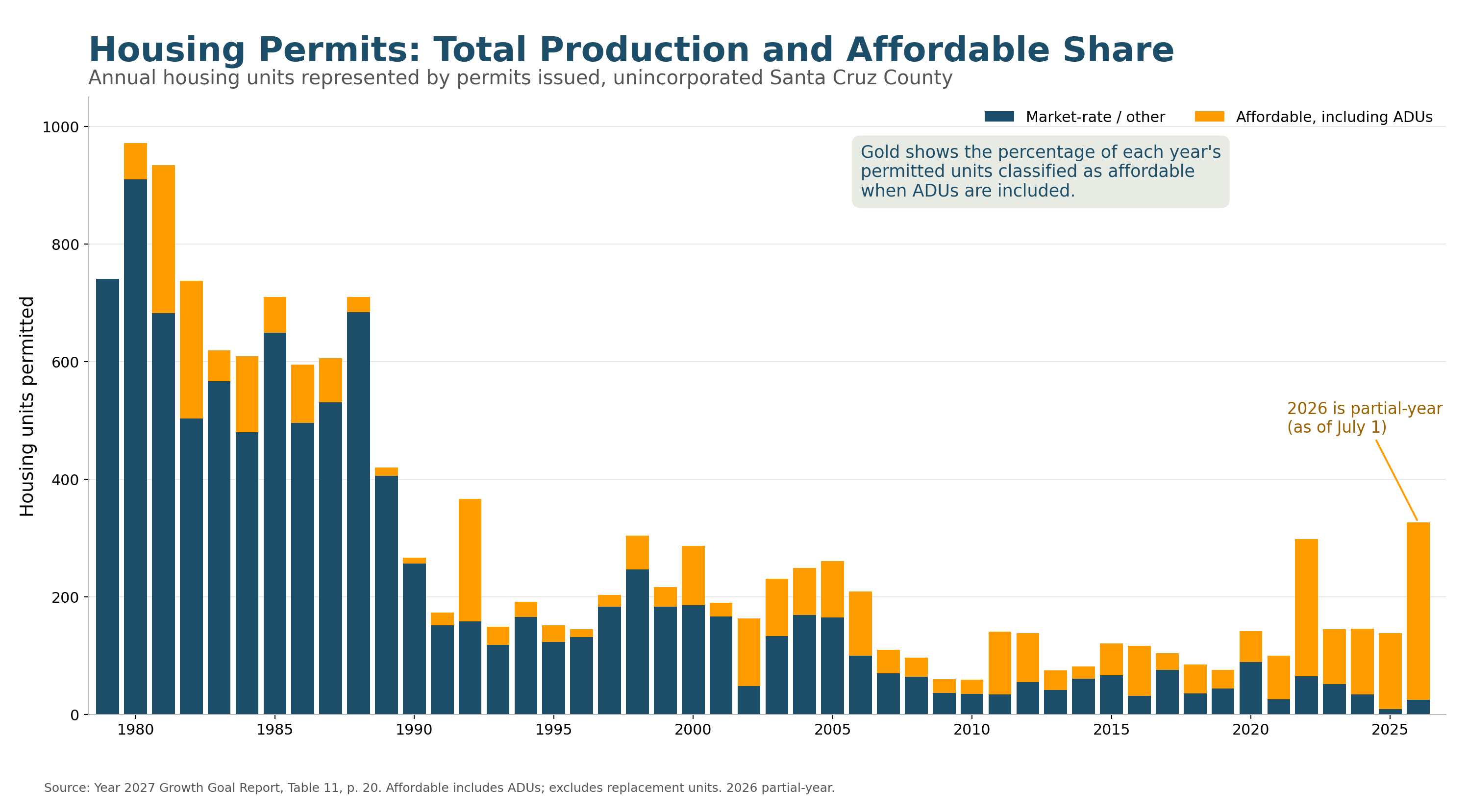
The County of Santa Cruz has made significant investments in affordable housing despite the loss of a critical funding source when California eliminated redevelopment agencies in 2012. Through successful efforts to secure additional state, federal and other funding, the County has continued to support affordable housing development, with income-restricted affordable units accounting for a majority of permitted housing production in the unincorporated area over nearly the past two decades.

The County has also embraced innovative approaches to addressing local housing needs, including allowing tiny homes on wheels and expanding opportunities for smaller, more affordable-by-design ADUs. These efforts are supported by a variety of programs that help property owners navigate permitting, access financing and overcome barriers to construction, creating more diverse and attainable housing options for Santa Cruz County residents.

Chart 3: Housing permits issued since 1980, showing both market-rate and affordable homes in Santa Cruz County.
Click to Enlarge

This has resulted in a variety of housing projects that serve low- and moderate-income households and people experiencing homelessness. Project Homekey grants have helped create housing for veterans, families and other people experiencing homelessness. County Behavioral Health has also secured and invested Mental Health Services Act (MHSA) funding to develop more than 200 supportive housing units at Harvey West Studios and Jessie Street Terrace in Santa Cruz, Bienestar Plaza in Live Oak, and Tabasa Gardens in Watsonville.

Chart 4: County supported affordable housing projects.

ADDITIONAL RESOURCES

Current Projects

Explore our current affordable housing projects to learn more about the subsidized 100% affordable housing developments currently in the pipeline.

Current Projects

Prohousing Designation

The County is applying to obtain this designation to make us eligible for various state incentive programs and funding opportunities for affordable homes and infrastructure.

Prohousing Designation

CAAP Design

The Climate Action and Adaptation Plan (CAAP) has been developed to support the County's strategic goals, foster collaborative solutions, and address equity concerns.

CAAP Design

Low-Barrier Centers

Low-Barrier Navigation Centers (LBNCs) are referral-only supportive housing sites that help people experiencing homelessness move toward permanent housing.

Low-Barrier Centers
TOP